

Which DTF Transfers Are Best for Custom Merchandise?
Editorial TeamLast Updated: October 28, 2026
Quick Summary
The best DTF transfers for custom merchandise are sharp, full-color prints made at 300 DPI on a transparent background, from a supplier with a clear reprint policy and no minimum order. DTF transfers work well for small runs because they need no screens, and their quality depends on print sharpness, adhesive cure, and correct pressing.
- Use a file at 300 DPI with a transparent background for the cleanest edges.
- Confirm minimum order, reprint policy, and turnaround in writing before buying.
- Run a wash test with three samples at 24 hours, five washes, and ten washes.
- Gang sheets lower the cost per design by combining several designs on one sheet.
- Press at the recommended temperature and pressure, and follow the film's peel instructions.
Table of Contents
- What DTF Transfers Are and How the Process Works
- What to Check Before You Order: Print Quality, Color, and Detail
- Custom DTF Transfers No Minimum Order: Testing Designs Without Overstocking
- Choosing a Best DTF Transfer Supplier for Small Business
- DTF Gang Sheet Printing: Layout, File Prep, and Cost Per Design
- DTF Transfer Durability and Wash Care
- Matching Each Transfer Option to Your Merchandise Use Case
- Order Your First Transfers: Size, Gang Sheet, or Upload
- Frequently Asked Questions
What DTF Transfers Are and How the Process Works
Direct-to-film (DTF) transfers are printed designs on a special film, coated with adhesive powder, that you press onto garments with a heat press. Choosing the best DTF transfers for custom merchandise starts with knowing how that process works, because the printing method shapes the quality you get. We print DTF 2 Print transfers at 300 DPI using eco-friendly inks, so each design comes off the film with sharp edges and full color.
The process runs in four steps. The design prints in reverse onto a clear film, adhesive powder is applied and cured, and the finished transfer is pressed onto the garment at the recommended temperature and time. Peel instructions vary by product, so follow the guidance printed with your order.
Many apparel sellers find DTF easier to start with than screen printing, since it needs no screens and works well for small runs. A common mistake is pressing without checking the film's peel instructions first, which can leave a dull or cracked finish.
What to Check Before You Order: Print Quality, Color, and Detail
Before placing an order, check three things: print sharpness, color accuracy, and how fine detail holds up. A file at 300 DPI with a transparent background gives you the cleanest edges, while a low-resolution image will look soft once pressed.
Custom DTF Transfers No Minimum Order: Testing Designs Without Overstocking
Ordering without a minimum quantity lets you test a design before committing to inventory, often the most practical way for a small shop to learn which designs sell. Our no-minimum ordering process lets you order the quantity you need.
If you are testing several designs at once, a DTF transfer by size order offers a size-based option.

Choosing a Best DTF Transfer Supplier for Small Business
The per-transfer price on a product page is only one line in the real cost of a finished shirt. Here are criteria to consider when evaluating suppliers.
The criteria that actually matter
- Print quality and consistency. Consistency across reorders matters when evaluating a supplier.
- Minimum order and size flexibility. Confirm whether minimums apply per design, per sheet, or per order.
- Turnaround and rush options. Standard turnaround, rush fees, and cutoff times affect whether you hit a launch date. Get these in writing.
- Shipping terms and pickup. Free shipping thresholds and local pickup are factors to consider.
- File handling and reprint policy. Ask what happens when a file prints unexpectedly, mislabeled color, dropped detail, or a size error. A clear reprint policy is worth more than a slightly lower unit price.
- Communication. A supplier who answers file questions before you order will usually answer them after.
A worked total-cost comparison
Build a spreadsheet with these columns for each supplier:
| Cost line | What to record |
|---|---|
| Transfer unit price | Price per transfer at the size you need |
| Setup or file fees | Any one-time charge per design or per order |
| Minimum order | The smallest order you can place, and its total |
| Shipping | Cost at your typical order size, and the free-shipping threshold |
| Rush fees | Cost to hit a specific date |
| Expected reprint rate | Your estimate of how often an order needs a reprint |
| Cost per finished shirt | (Transfer + setup + shipping + rush) ÷ number of shirts in the order |
A vetting checklist before your first bulk order
- Inspect edges, color, and hand-feel.
- Confirm the minimum order in writing.
- Ask for the reprint policy on file errors and print defects.
- Confirm shipping cost and the free-shipping threshold at your order size.
- Test the file submission process with a small order before committing to a large one.
- Check whether local pickup saves you time or shipping.
Red flags
- No sample option and no reprint policy.
- Prices that are dramatically below market with no explanation of the film or powder used.
- Vague answers on turnaround or rush cutoffs.
- No way to confirm how files will be handled before you pay.
DTF 2 Print offers free shipping on orders over $100 and local pickup in Van Alstyne, TX.
DTF Gang Sheet Printing: Layout, File Prep, and Cost Per Design
A gang sheet combines several designs onto one printed sheet, which lowers the cost per design. Our guide to setting the sheet size correctly in the builder walks through each step. Arrange designs with enough space between them so the transfers can be cut cleanly and pressed without overlap.
![A small apparel business owner reviewing a printed DTF transfer sheet with several designs laid out on a worktable in a bright studio workspace]
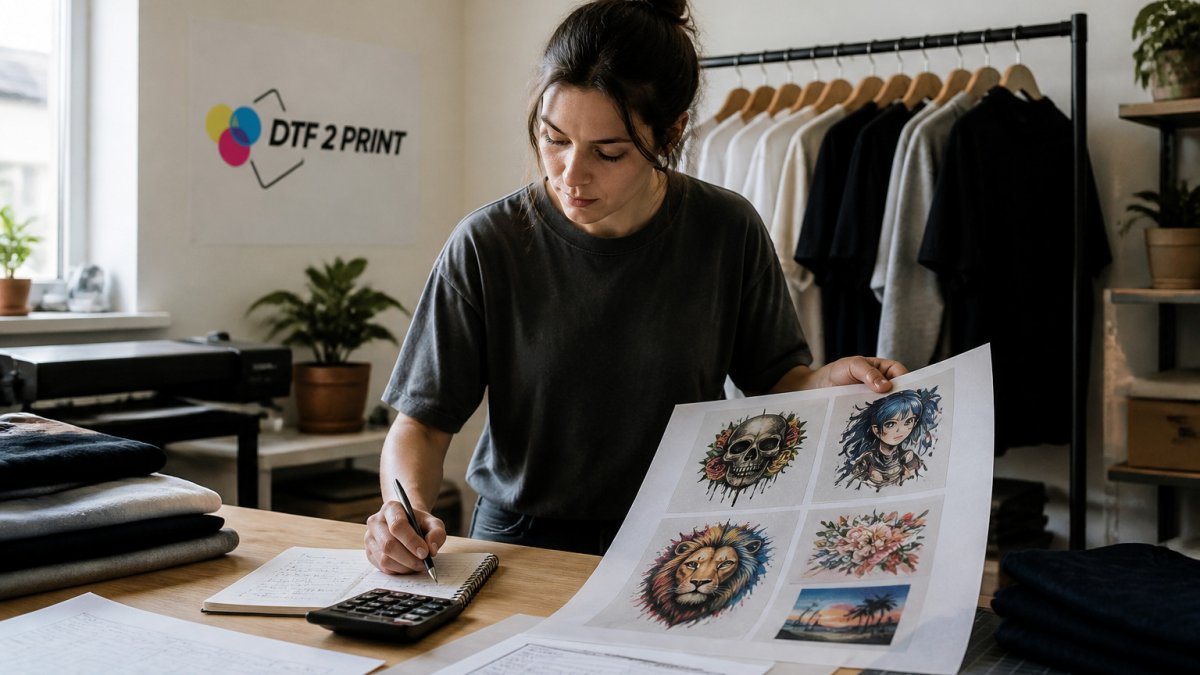
Our build your DTF gang sheet tool lets you place multiple designs on one sheet.

DTF Transfer Durability and Wash Care
Here are factors to consider when evaluating DTF transfer durability.
What determines DTF transfer longevity
Four variables drive how a pressed DTF transfer holds up:
- Adhesive powder cure. Under-cured powder leaves a weak bond that peels at the edges; over-cured powder becomes brittle and cracks. The cure is set by the supplier, so ask how they cure and at what temperature.
- Press pressure and temperature. A transfer pressed too cool or too light will not fully activate the adhesive. Too hot or too heavy and the film can scorch or the adhesive can bleed.
- Peel timing. Hot-peel, cold-peel, and warm-peel films behave differently. Peeling a cold-peel transfer too early stretches the design; peeling a hot-peel transfer too late can leave adhesive residue on the carrier film instead of the garment.
- Fabric composition. Cotton holds DTF well; polyester and polyester-rich blends are more prone to dye migration and to a stiffer hand-feel after pressing. Very stretchy knits stress the transfer at the seams.
A simple wash-test method you can run yourself
Most suppliers claim their transfers are "wash-safe," but the claim is only useful if you can verify it. Run this test on any new supplier before a bulk order:
- Press the same artwork onto the same garment type you plan to sell, following the supplier's recommended temperature, time, and pressure.
- Produce at least three identical samples so you can compare results.
- Wash one sample after 24 hours, one after five washes, and one after ten washes.
- Use cold water on a normal cycle, turn the garment inside out, and tumble dry low, the same conditions your customers will likely use.
- After each wash, inspect edges for lifting, check the design for cracking, and note any change in hand-feel or color.
Record the results. A transfer that survives ten washes with intact edges and no visible cracking is a reasonable benchmark for retail merchandise. If edges lift after the first wash, the problem is usually press pressure or peel timing, not the film.
Common failure modes and what they mean
- Edges lifting after washing. Almost always insufficient pressure or a peel that happened at the wrong temperature. Re-press a test garment at higher pressure before blaming the transfer.
- Cracking across the design. Usually over-curing or a garment stretched during pressing. Check that the garment is flat and cool before pressing.
- Stiff, plastic hand-feel. Common on high-polyester garments and on transfers with heavy ink coverage. Smaller designs and lower-coverage artwork feel softer.
- Color fading or bleeding. More common on dark polyester, where dye migration can push garment dye into the transfer. A poly-blocker underlayer or a lower press temperature can help.
- Adhesive residue on the carrier film. A sign the transfer was peeled too cool for a hot-peel film, or that pressure was too low to transfer the adhesive fully.
Garment-specific care guidance
- 100% cotton: the most forgiving substrate. Cold wash, inside out, tumble dry low. Expect the longest life here.
- Polyester and poly-blends: wash cold and dry low; high heat accelerates dye migration and can stiffen the transfer.
- Stretch knits and athletic wear: expect some stress at the seams. A slightly larger transfer with rounded corners distributes stress better than a small, sharp-cornered design.
- Garments with zippers or heavy seams: press around hardware, not over it, and warn customers to wash inside out to avoid abrasion.
What to ask a supplier about durability
Our transfers offer excellent stretch and feel on garments and are compatible with cotton, polyester, and blends.
Matching Each Transfer Option to Your Merchandise Use Case
Different merchandise calls for different choices. DTF transfers by size are available for apparel projects, and gang sheets let you fit multiple designs onto one sheet.
Think through the use case first:
- Multiple designs for a launch: use a gang sheet to combine them.
Order Your First Transfers: Size, Gang Sheet, or Upload
For a size-based option, see DTF transfer by size. For several designs combined, see the build your DTF gang sheet option.
If your artwork is ready to go, you can upload your artwork directly.
Frequently Asked Questions
What should I look for in a high-quality DTF transfer?
Look at print sharpness, color accuracy against your original artwork, and how the transfer feels once pressed.
Can I order custom DTF transfers with no minimum?
Yes. DTF 2 Print offers no minimum quantity requirements. The DTF Transfer By Size product is listed at $0.10, and Build Your DTF Gang Sheet is listed at $4.99. Free shipping applies to orders of $100 or more, and local pickup is available in Van Alstyne, TX.
Are DTF transfers durable after repeated washing?
DTF transfers are designed to be wash-safe and stretchable, and they are compatible with cotton, polyester, and blends.
What fabrics can DTF transfers be applied to?
DTF 2 Print's transfers work on cotton, polyester, blended fabrics, and fleece.
