

DTF vs Screen Printing for Small Batches
Editorial TeamTable of Contents
- DTF vs Screen Printing for Small Batches: Quick Overview
- DTF vs Screen Printing Cost: What You'll Actually Pay
- Screen Printing Minimum Order Quantity and Small-Batch Limitations
- DTF vs Screen Printing Durability: Wash Tests and Real-World Performance
- DTF Printing on Cotton and Polyester: Fabric Compatibility
- Design Complexity and Color Count: Which Method Handles What
- Turnaround Time and Workflow for Small Orders
- Which Method Should You Choose for Small Batches
- Frequently Asked Questions
Last Updated: October 21, 2026
DTF vs Screen Printing for Small Batches: Quick Overview
For a small apparel operation, choosing between DTF and screen printing shapes your costs, turnaround time, design options, and final quality. DTF vs screen printing for small batches comes down to one tension: DTF wins on flexibility and full-color capability, while screen printing excels at durability and per-unit cost at volume.
Direct-to-film printing applies designs to garments through a heat press, with no screens or complex setup. Screen printing uses mesh screens and ink, layer by layer. For small orders of 5 to 50 units, the economics shift dramatically compared to bulk production.
The real question isn't which method is "better", it's which one matches your order size, design complexity, and budget right now.
DTF vs Screen Printing Cost: What You'll Actually Pay
Cost drives most small-batch decisions, but the comparison only works when you model it by order quantity. A per-shirt price in isolation hides setup fees, minimums, artwork prep, application labor, and spoilage.
Setup Costs and Minimum Order Quantities
Screen printing demands physical setup: screens burned, ink mixed, presses calibrated. A common pattern is $20 to $45 per color for screen setup on small runs, with many shops enforcing minimums of 12 to 36 units.
DTF printing has virtually no setup cost: no screens, no color-specific prep. You upload artwork and production starts. Most DTF providers, including DTF 2 Print, have no minimum order quantity, you can order a single transfer.
That matters most for testing. Screen printing's minimums lock you into inventory risk when validating a new design; DTF lets you start with whatever quantity makes sense.
Per-Shirt Pricing and Break-Even Analysis
DTF transfers start at $0.10 by size, or you can build a custom gang sheet for $4.99. At DTF 2 Print, transfers start at $0.10 by size, or you can build a custom gang sheet for $4.99.

The break-even point depends on your design. A simple one-color screen print costs less per unit at higher volumes, but a complex five-color design flips the math because DTF avoids per-color setup fees.
| Order Size | DTF Cost Per Unit | Screen Printing Cost Per Unit | Better Choice |
|---|---|---|---|
| 5-10 units | $0.50-$1.50 | $2.50-$5.00 | DTF |
| 25-50 units | $0.40-$1.00 | $1.50-$2.50 | DTF |
| 100+ units | $0.30-$0.80 | $0.75-$1.50 | Screen Printing |
| 250+ units | $0.25-$0.60 | $0.50-$1.00 | Screen Printing |
Total Cost Beyond the Print
The per-shirt price is only part of the story. Artwork prep, application, shipping, spoilage, labor, and rush fees can swing the comparison by 20 to 40 percent.
Artwork prep: screen printers often charge $25 to $75 to separate colors and output film, while DTF providers typically accept print-ready files with no separation fee. Application: DTF needs a heat press and 30 to 60 seconds per shirt.
A realistic small-batch budget should include all of these line items, not just the print quote. That is the number to compare when you decide between DTF and screen printing.
Screen Printing Minimum Order Quantity and Small-Batch Limitations
Screen printing's infrastructure creates friction for small batches. Every color requires its own screen. Every screen requires setup time. Shops stack that cost into minimums to stay profitable.
Print 12 shirts with a three-color design and the printer burns three screens for a short job.
DTF printing eliminates this constraint. You order exactly what you need, reorder the same day if a design sells fast, and only invest in what moves.
DTF vs Screen Printing Durability: Wash Tests and Real-World Performance
Durability concerns drive many small-batch buyers toward screen printing, assuming it lasts forever while DTF peels after a few washes. The reality is more nuanced, and a fair comparison requires stated test conditions and failure modes.
How to Compare Durability Fairly
A useful durability comparison controls for four variables: the garment (same fabric and weight), the application (correct heat, pressure, and cure time), the wash protocol (temperature, detergent, cycle, drying), and the inspection criteria (cracking, peeling, fading, edge wear). Without those controls, anecdotes tell you nothing about the method.
A common pattern among practitioners is to wash test garments inside out in warm water with normal detergent, tumble dry low, and inspect every 10 cycles. Under those conditions, quality DTF transfers commonly survive 50 or more cycles without visible degradation, while screen prints commonly last 75 or more cycles.
Print Feel and Fabric Hand
Screen printing creates a raised, slightly stiff texture you can feel. For thick coverage or metallic inks, that texture becomes part of the aesthetic.
DTF transfers have a smooth, matte finish that blends into the fabric. The hand feel is softer. Most wearers can't tell the transfer from the garment itself.
If your customers value a soft, unnoticeable print, DTF wins. If they expect that tactile, slightly raised look, screen printing delivers it.
Cracking, Peeling, and Fading Over Time
DTF transfers can peel if applied at incorrect heat or pressure and fade under intense UV or chlorine. Screen prints can crack if fabric stretches aggressively or ink is applied too thick. Both fail when application is wrong and succeed when it's right.
The mechanism differs. DTF bonds through an adhesive powder that fuses to the fabric under heat, so failure usually starts at the edges where the film lifts. Screen printing ink sits on the surface and sinks into the weave, so failure usually appears as cracking across the print area as the fabric flexes.
Small-Batch Workflow and Reorders
Durability also affects reorders. A screen-printed batch can be reprinted from the same screens if the shop kept them, supporting consistency. A DTF batch can be reprinted from the same digital file at any quantity, supporting late design changes and low inventory risk. If consistency across many reorders matters, ask your provider how they store screens or files before you commit.
DTF Printing on Cotton and Polyester: Fabric Compatibility
DTF transfers work on cotton, polyester, cotton-polyester blends, fleece, and performance fabrics. The adhesive powder and heat bonding work across fiber types.
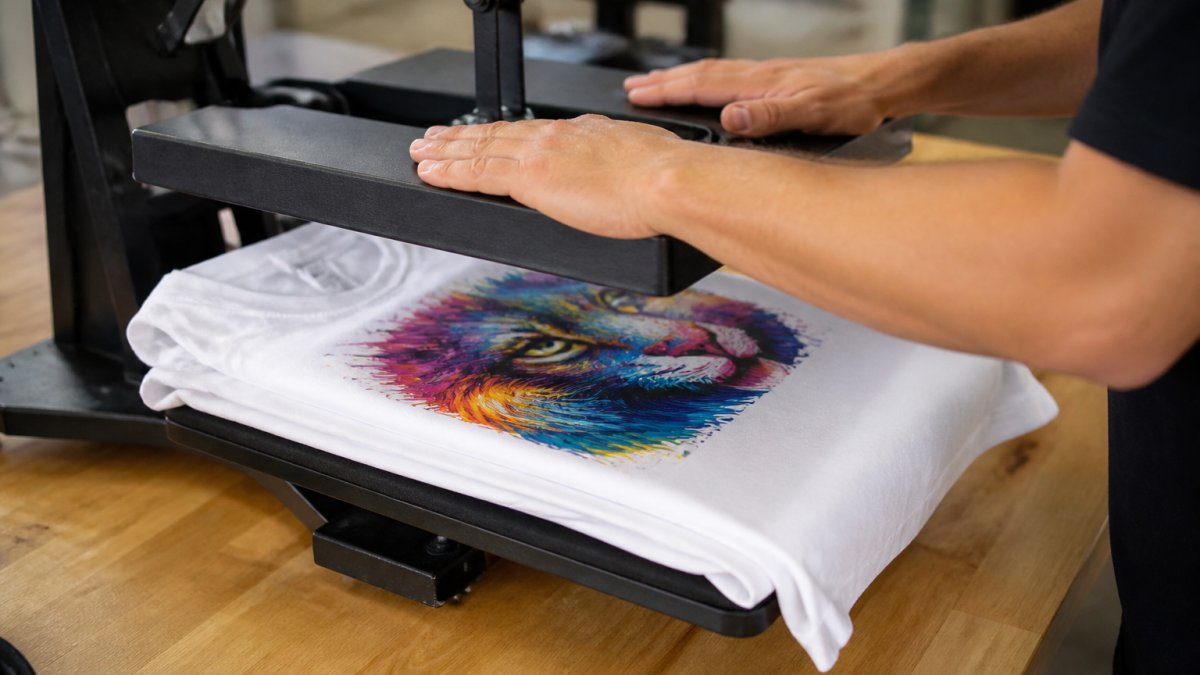
For light-colored garments, both methods work equally well. On dark garments, DTF has an advantage: the white adhesive powder base ensures colors pop without light-colored blanks.
Screen printing on dark shirts requires light-colored ink or a white underbase layer, adding complexity and cost. DTF handles dark garments naturally.
Polyester and synthetic blends have lower melting points than cotton, so incorrect heat can damage the fibers.
Design Complexity and Color Count: Which Method Handles What
This is where DTF vs screen printing for small batches diverges most sharply.
Full-Color and Photo-Realistic Artwork
DTF transfers handle unlimited colors in a single pass, photorealistic images, gradients, complex illustrations, multi-color designs, with no per-color setup fees. A 10-color design costs the same as a one-color design, just more ink and film.
Screen printing requires one screen per color: a 10-color design means 10 screens, 10 setups, and 10 passes through the press. Most screen printers cap at 4 to 6 colors for small runs.
For brands selling designs with photographs, gradients, or complex artwork, DTF is the only practical choice at small volumes.
Simple Prints and Single-Color Designs
Simple designs, a logo, a text line, a single-color graphic, cost less to screen print than DTF above 50 units. One screen, one setup, one pass.
Below 50 units, DTF's no-setup advantage flips the equation: you pay for the transfer and gang sheet, not screen labor.

The practical reality: if your design is simple and you're ordering over 100 units, get quotes from both methods. If your design is complex or your order is under 50 units, DTF wins on cost and flexibility.
Turnaround Time and Workflow for Small Orders
Screen printing typically takes 5 to 10 business days for small orders, since the shop must burn screens, mix inks, and schedule press time around larger jobs.
DTF printing can turn around in 1 to 3 business days. No screen burning. No ink mixing. Just upload, print, and ship.
For brands with tight deadlines or reorder cycles, DTF's speed is transformative: you respond to demand in real time instead of planning weeks ahead.
DTF 2 Print offers fast turnaround on all orders, with no minimums required. This workflow flexibility lets small brands compete with larger competitors on speed.
Which Method Should You Choose for Small Batches
Start with your design. If it's complex, multi-color, or photo-realistic, DTF is the clear winner on cost and turnaround.
If your design is simple, one or two colors, and you're ordering over 100 units, get screen printing quotes.
Consider reorder frequency. Printing the same design repeatedly? Screen printing's per-unit cost eventually wins.
Think about fabric. Light garments: both methods work.
For most small-batch operations, Etsy sellers, print shops handling overflow, independent designers, local businesses, DTF is the practical choice.
At DTF 2 Print, we've built our entire service around this reality.
Frequently Asked Questions
Is DTF or screen printing cheaper for small batches?
DTF is typically cheaper for small batches because it has no setup fees or minimum order quantities. Screen printing requires screen setup costs, making it uneconomical for orders under 25-50 units. DTF transfers start at $0.10 per transfer with no minimums, so a 5-shirt order costs just $0.50 in transfer fees plus shipping. Screen printing becomes cost-effective only at higher volumes where per-shirt costs drop below DTF.
What is the break-even point between DTF and screen printing?
Break-even typically occurs around 50-100 units, depending on design complexity and color count. At 50 shirts, screen printing's per-unit cost drops after spreading setup costs across the batch. DTF remains consistent. For orders under 50 units, DTF saves money. Above 100 units with simple designs, screen printing usually wins on per-shirt cost, though DTF remains competitive for multicolor or photo-realistic work.
Does DTF or screen printing last longer?
Both methods can last 50+ wash cycles with proper care, but durability depends on technique and fabric. DTF transfers with proper curing and adhesive powder application resist cracking and peeling well on cotton, polyester, and blends. Screen printing with quality plastisol ink also resists fading and cracking. DTF has an edge on stretchy fabrics and complex designs because the transfer flexes with the garment. Screen printing can feel stiffer but offers excellent durability on simple, bold designs.
Can DTF transfers be used on cotton and polyester?
Yes, DTF transfers work on cotton, polyester, blends, and performance fabrics. They adhere well to light and dark garments through heat-press application with adhesive powder. The transfer remains flexible and breathable on both fabric types. Polyester and moisture-wicking synthetics work particularly well because DTF transfers cure into the fibers without blocking moisture. Cotton also performs well, though darker cotton may require slightly higher heat for optimal adhesion.
Which printing method is better for multicolor designs in small quantities?
DTF is significantly better for multicolor designs in small quantities. Screen printing requires a separate screen for each color, multiplying setup costs and complexity. DTF prints unlimited colors on one transfer at no extra cost. Full-color, gradient, and photo-realistic artwork all print identically on DTF without additional screens or setup time, making it ideal for custom, complex designs at any volume.
The choice between DTF and screen printing for small batches comes down to your specific needs: design complexity, order volume, timeline, and fabric type. DTF 2 Print specializes in small-batch flexibility with vibrant, durable transfers on cotton, polyester, and blends. Start building your gang sheet today with our custom gang sheet builder, or order transfers by size for exactly what your project needs. Get professional-grade results without minimums or long lead times.